Ritual is a Chrome extension I built for my own brain first. It replaces Chrome's new tab page with a calm one. It keeps my tasks, a journal and a timer one hover away on every website. Before I open a site that tends to eat my afternoon, it asks for a short, honest pause. This is how I made it, what I decided along the way, and what happened to my own time.

RoleDesigner and builder, working solo with an AI coding assistant
StatusLive on the Chrome Web Store. There is a Firefox build too, and a live landing site.
Read8 minutes

01

Why

I had tried blocking. It never lasted.

Every site blocker I tried went the same way. I'd have a week of good behavior, then a day when I needed to check one thing on a blocked site, and then I'd uninstall it. The one that lasted simply made me wait five seconds before a site opened. Willpower was never the difference. What worked was a small obstacle of exactly the right size.

Blocker 1

The wall

It blocked a list of sites completely. That felt great for six days. On day seven I needed a recipe from one of those sites.

Blocker 2

The ten-second wait

Every blocked site made me sit through ten seconds. By day three I was deleting the extension to make it stop.

Blocker 3

The five-second wait

The same idea with half the wait, and I kept it for months. Five seconds was long enough to notice and short enough not to resent.

Environmental design for my brain.

Treat the computer as a room you can arrange, rather than a temptation you have to resist. Remove the obstacles in front of the thing you meant to do. Put a small, honest obstacle in front of the thing you didn't mean to do, and keep it flexible enough that you never have to fight it. Nothing here asks you to be stronger. It asks you to arrange the room better.

02

Plan my day

One button, a day with gaps in it.

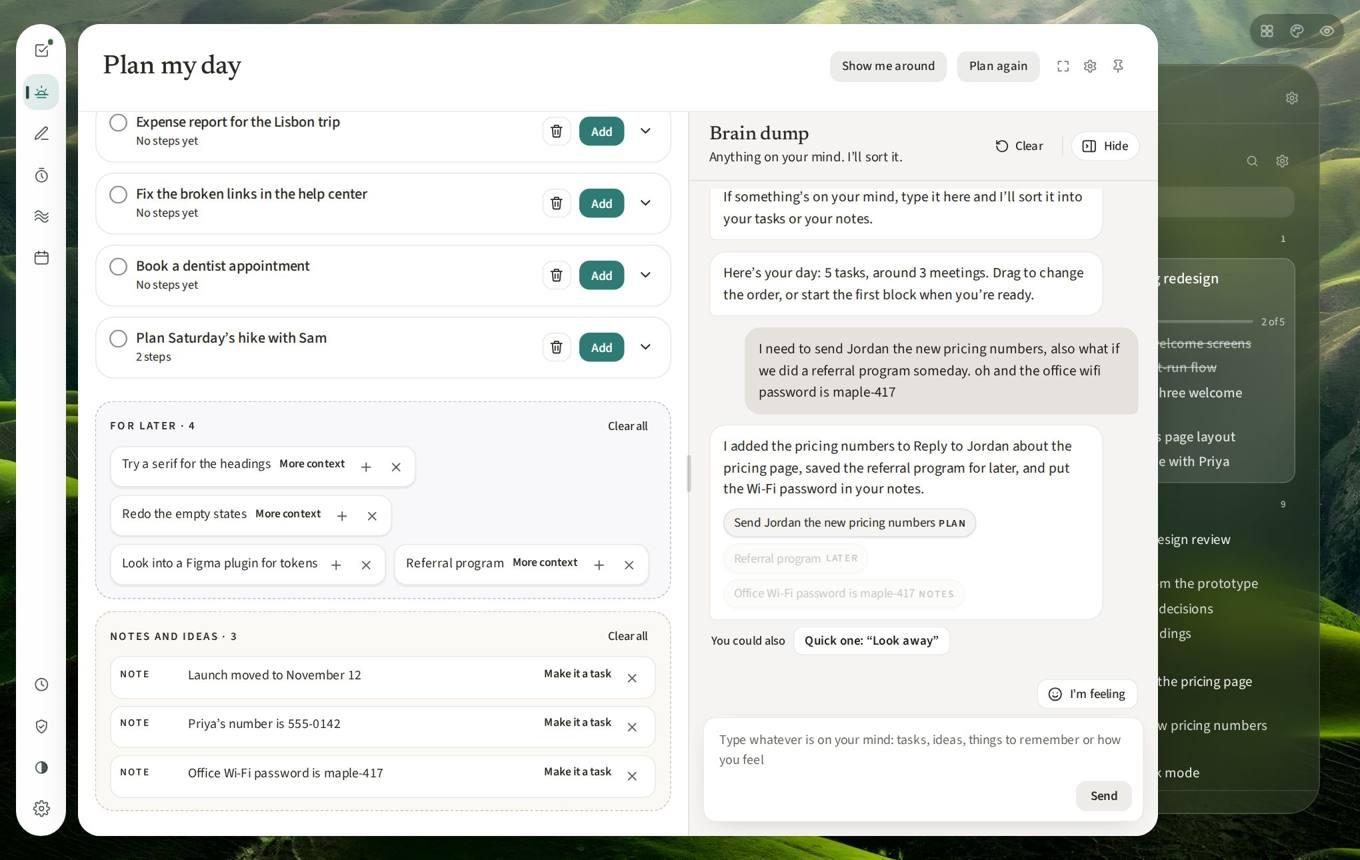
Ritual looks at your deadlines, your priorities and your calendar. Then it fits a few tasks around your meetings, with breaks in between. Beside the plan is a brain dump, a box for whatever is on your mind. Ritual sorts what you type there. Tasks go into the plan, ideas go to a For later list, and facts go into your notes. Try it below. This demo is a sample day sorted by simple rules. The real version runs on an AI model, using an API key from your own AI account.

New Tab · Plan my day

Today

    For later · 0

    Notes · 0

    Brain dump

    Anything on your mind. I'll sort it.

    If something's on your mind, type it here and I'll sort it into your tasks or your notes.
    Try

    03

    Inside

    Two surfaces, one quiet room.

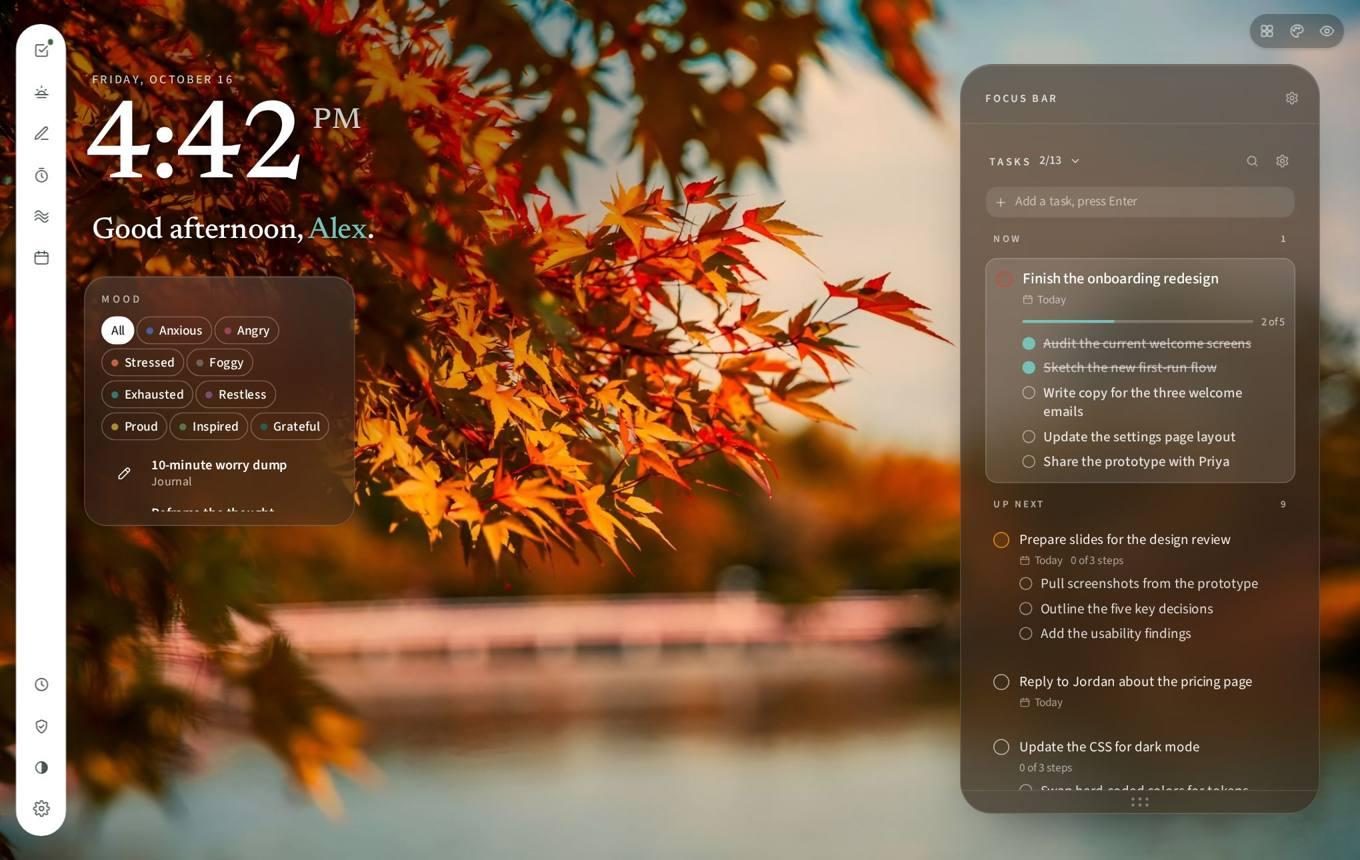
    The new tab page is where the day starts. The rail is a slim panel with the same tools, tucked at the edge of every other web page. As you scroll, the screenshot changes to match the text.

    New tab

    Time, one greeting, nothing else.

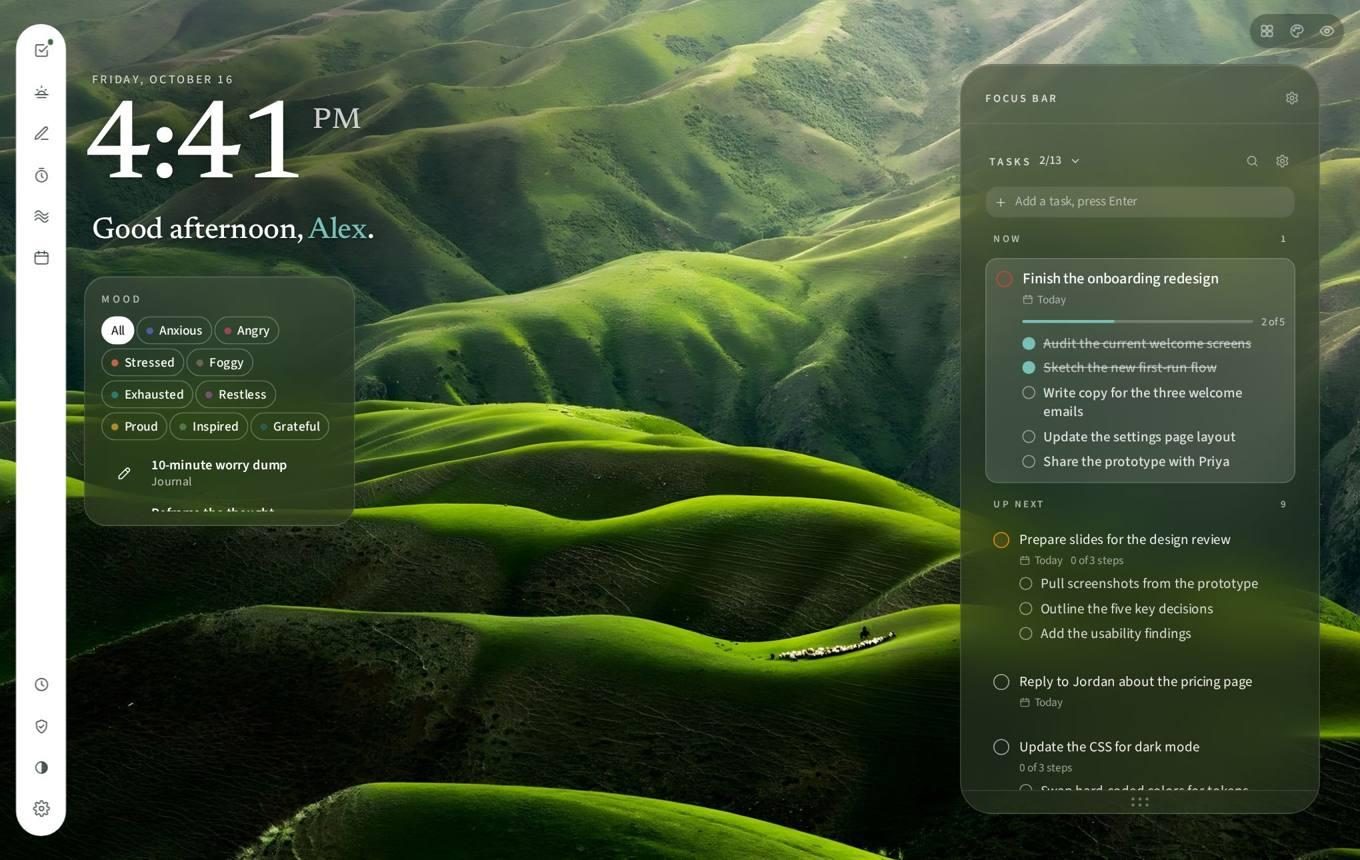
    The time in large numerals, the date, a greeting that changes with the hour, and a row for picking your mood, which the rest of Ritual quietly takes into account. Everything else is a hover away. You choose the wallpaper, and the text color adapts to it.

    What I cut: quick links, music, a weather widget, and the "Today's ritual" line in the greeting.

    Plan my day

    Plan the day, then empty your head.

    Ritual looks at your deadlines, your priorities and your calendar. It picks the tasks it would do first and fits them around your meetings, with breaks in between. Beside the plan is the brain dump. A step you type there is added to the right task, an idea goes to For later, and a fact goes into notes.

    • It knows when it's not a task. Say you feel scattered and it offers a short exercise. Say you're stuck and it offers the smallest next step.
    • Full sentences. It asks "How are you feeling today?" instead of "How are you arriving?"

    Deep Focus

    Give the next hour some shape.

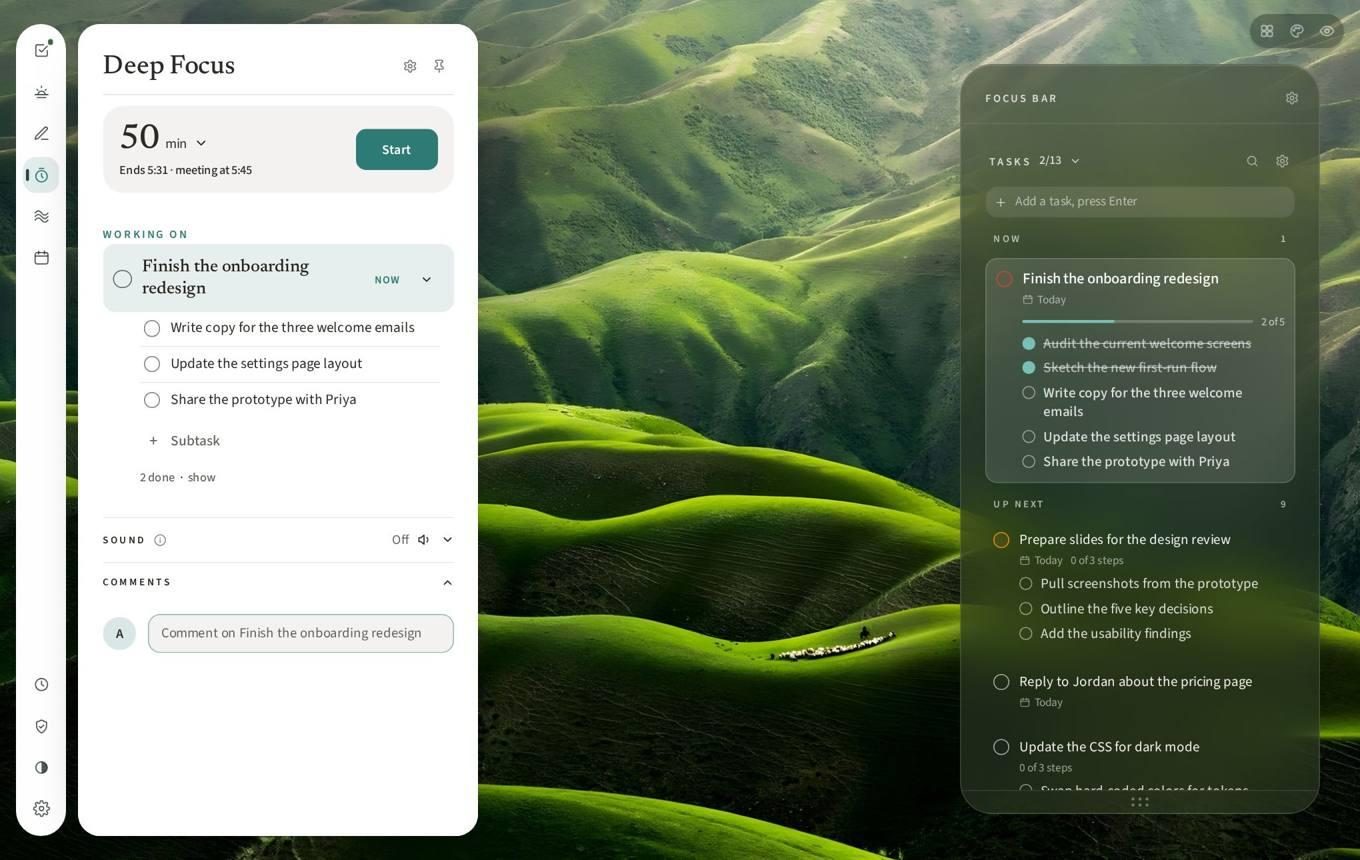
    A timer shows the task you are on and its steps, with a background soundscape. At the end, a bell rings that sounds like a real bell rather than a notification. When the session ends you can switch tasks from the same screen. The old Done screen was a dead end, with nowhere to go next.

    What I cut: pasting in your own playlist links. The sounds are hand-picked, and that is the point.

    Recharge and Journal

    Small resets for how you feel.

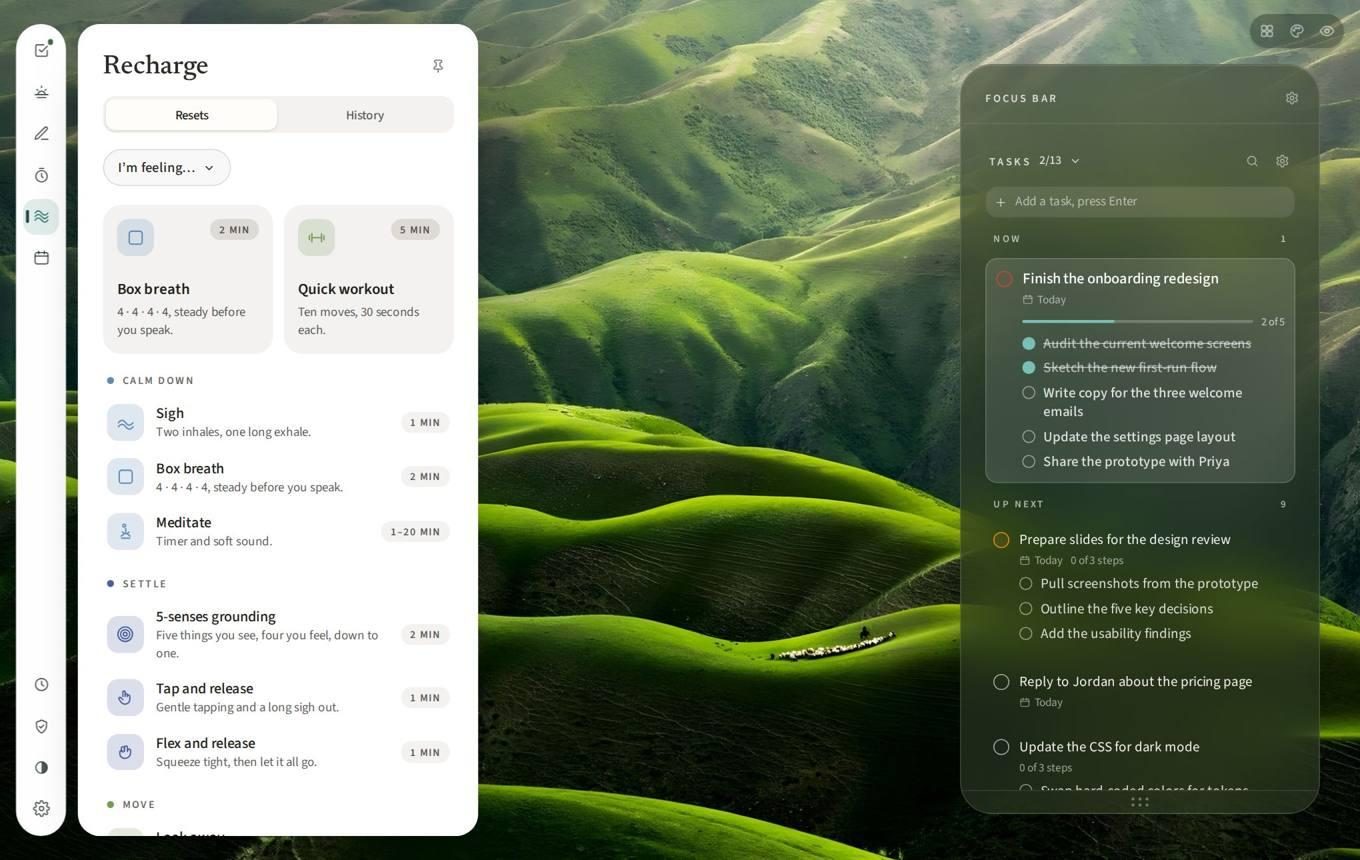
    Pick how you feel, then pick a reset. The options include a sigh, box breathing, a quick workout, five-senses grounding, and a ten-minute worry dump with a timer. The journal has two modes, Write and Guided. Guided uses the same library, sorted under single-word feelings. Everything is visible, and nothing is mandatory.

    • Nothing reads the journal. No AI model, on your computer or online, ever analyzes an entry. This is a firm rule, so there is no setting to change it.
    • Breathing is never suggested. When I'm stuck, "stand up" is a more useful nudge than "breathe".

    Blocked sites

    A moment to decide.

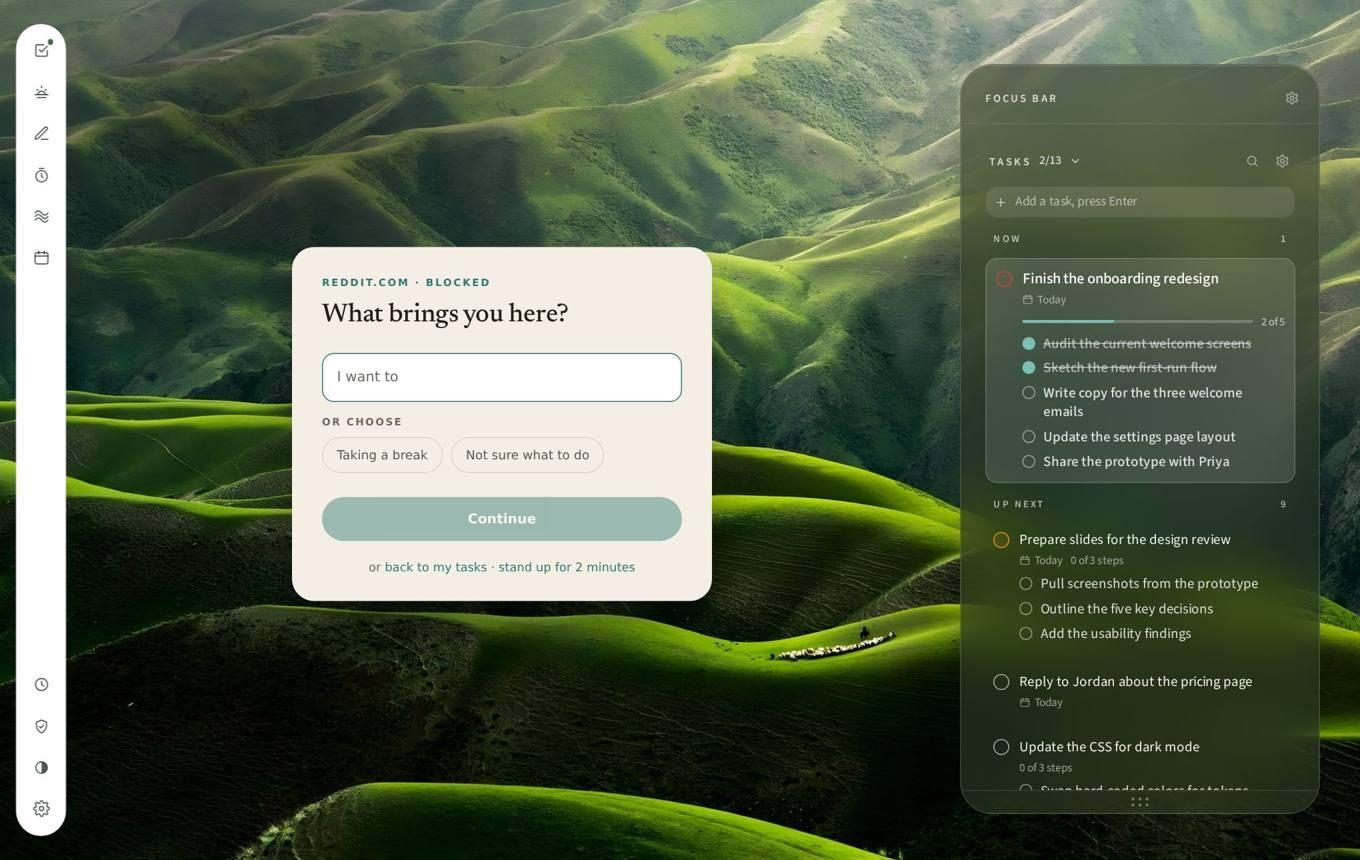
    This is the turn-back screen. The site blurs, Ritual asks what you came for, and the Continue button stays locked for five seconds. You can block whole groups of addresses with wildcard patterns, give each site its own schedule, and pick a better place to go instead of each one. Two related tools sit alongside it. Recolor turns a site gray on a schedule, and Quiet feeds hides just the feed while keeping the search.

    Calendar and Your time

    See the day, and where it went.

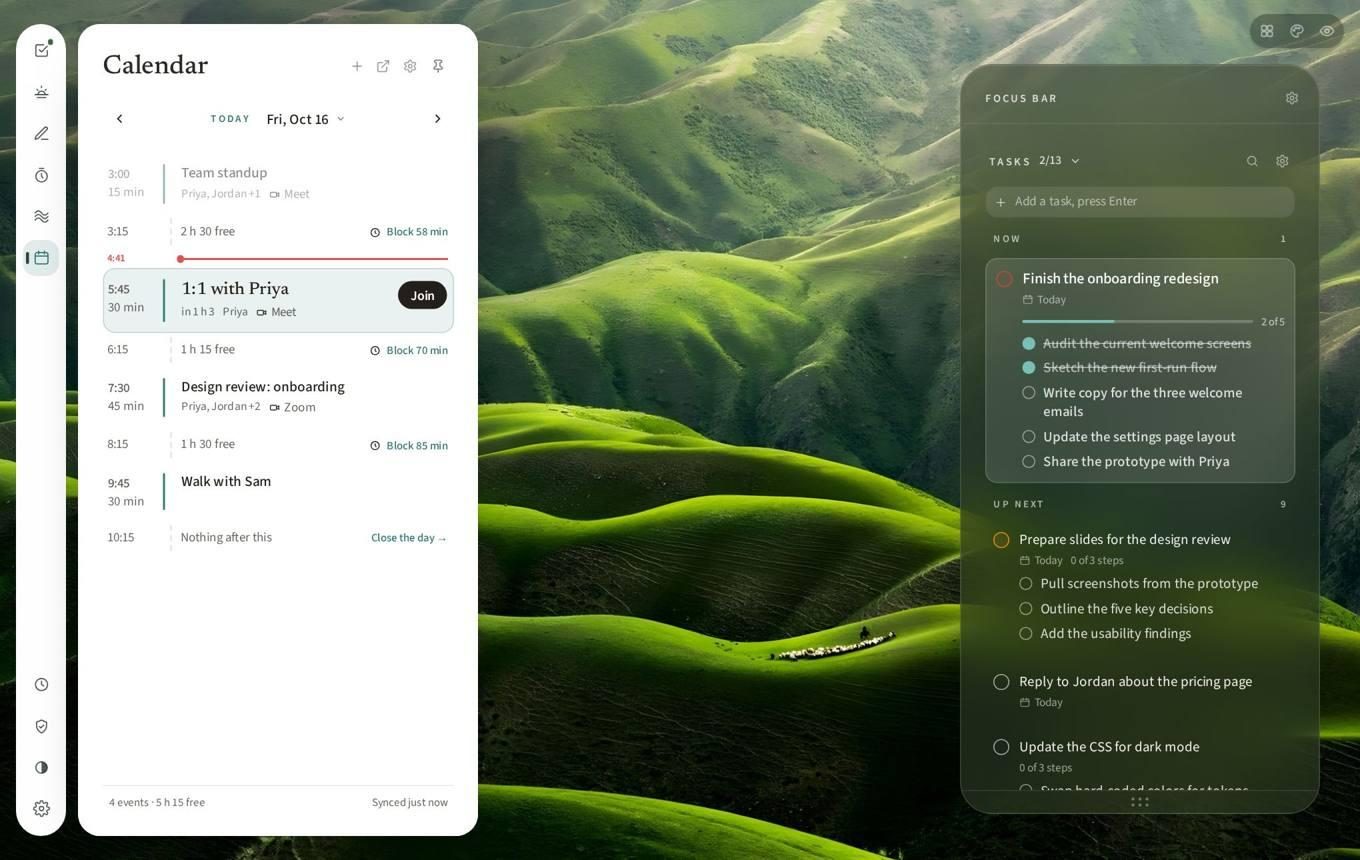
    The calendar shows in the rail even before you connect it, because nobody sets up a calendar they can't see. Once connected, it shows the day as a timeline. The free gaps are as visible as the meetings, and each event has a Recharge button. Your time counts how long you spend on each site. It counts on your own computer, and only you can see it.

    Make it yours

    A room you set up yourself.

    You can choose the wallpaper (video included), an accent color picked along one hue scale rather than from swatches, the typeface and the atmosphere. Personalisation does real work here. If you arranged the room yourself, using it feels like a choice rather than autopilot. That idea is what the whole product rests on.
    New Tab
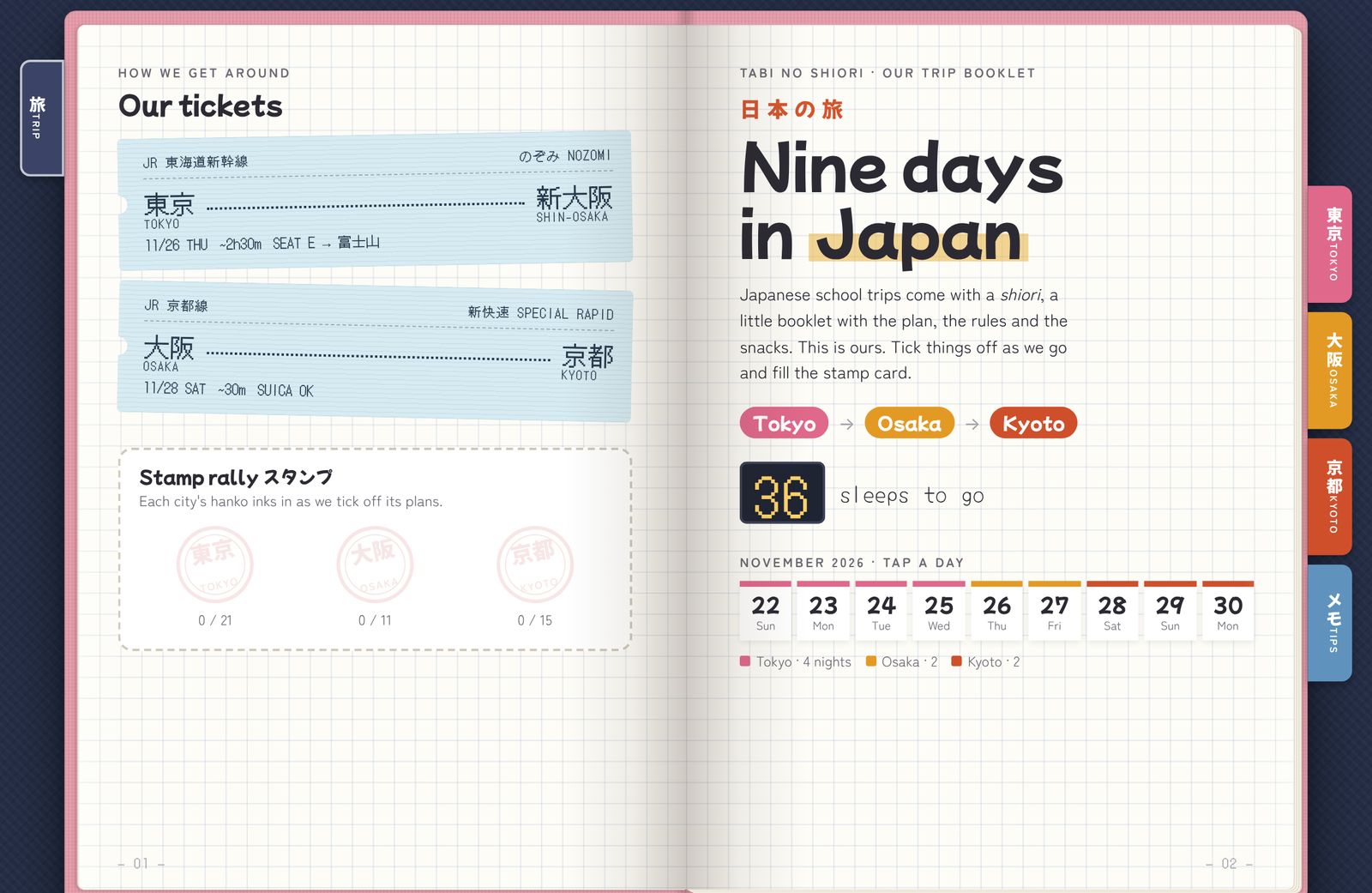
    Ritual's new tab over the valley wallpaper, with the time, a greeting and the mood row, the rail on the left and the Focus bar on the right. Plan my day: a proposed list of tasks beside a brain dump conversation. Deep Focus: a 50-minute timer with the current task and its steps. Recharge: resets grouped by feeling, from Sigh and Box breath to a quick workout. The turn-back screen over reddit.com: What brings you here, a reason box, and Continue. Calendar: the day as a timeline with meetings and free blocks. The new tab with an autumn wallpaper.

    04

    Decisions

    What's on, what's off, and why.

    Ritual is a personal project, so most of these decisions were tested only through my own use. I've tried to be clear which are principles I'd defend and which are preferences I happen to hold. Much of what shaped the product was what I chose to leave out.

    Substitute instead of block

    Every blocked site sends you to a place you chose in advance. The pause lasts five seconds, and you type your reason in your own words. An AI check asks for more if the answer is vague. Ritual never simply refuses a site.

    Principle. The version that blocked sites outright lasted six days.

    On

    One task in Now

    The task list has exactly one slot at the top, called Now. Everything else waits below it. Daily rituals sit above the list as cards.

    Principle. Two things in Now would be a list, and a list is what I was trying to avoid.

    On

    The AI thinks instead of filling in templates

    Plan my day, Break it down and the check-in at the pause all run on an AI model, using your own API key. Before that I tried a small model that runs on your computer, and then pre-written responses. Both felt flat.

    Preference, strongly held. Ritual's job is to be worth coming back to, and flat answers kill that.

    On

    Nothing reads the journal

    No AI model, on your computer or online, analyzes entries or pulls snippets from them. Your answers to the Reflect prompts are gathered into one entry per day, and an empty reflection is never saved.

    Principle. It's a firm rule, so there is no setting to change it.

    On

    Calendar visible before it's set up

    An empty calendar panel stays in the rail. If it were hidden, nobody would ever set it up.

    Principle. What a product shows by default is a design decision.

    On

    Streaks, on daily rituals only

    I removed streaks everywhere, then brought them back for daily rituals only, with an off switch. Scores never came back.

    Preference. I like a streak on a habit and hate one on a product.

    On · optional

    Quick links and music in the rail

    Both shipped in the first month, and neither was still in use by the second. The rail has one icon per tool, and I already had both of these tools elsewhere.

    Cut. That was the month Ritual turned into a kitchen drawer of odds and ends.

    Off

    Breathing as a suggestion

    Never offered as a nudge before a focus block or a meeting. Kept inside the Recharge toolkit for when you ask for it.

    Cut, after noticing I skipped it every time.

    Off

    A small local model

    I tried a small model that runs on your computer, so the AI features wouldn't need an API key. The answers felt predetermined, and it showed.

    Cut. Now the AI features use your own API key, or don't run at all.

    Off

    Multiple-choice reasons at the pause

    There were three options, and I always chose the easiest. It taught me nothing about why I was on the site.

    Cut. Now you type your own reason, and Ritual asks for more if it's vague.

    Off

    05

    The voice

    Calm, in full sentences.

    Most wellness software talks in shorthand that assumes you are already in the mood. Ritual asks a plain question and waits. Calm words like settle, breathe, gently and space are fine. But each sentence has to be one a person would say to someone who has just sat down with a lot to do.

    What it doesn't sayHow are you arriving?Set your intention for this session.You've broken your streak.Blocked. Try again later.
    What it saysHow are you feeling today?Good. Keep it small and finish the first one. Here's your plan.You've been on this for a while. Stand up for two minutes?What brings you here?

    06

    In my own use

    What I observed in my own use.

    These are notes from my own use, each with where it comes from. They describe how Ritual fits one person's routine. They are not evidence of an effect across users.

    Observation

    MonthsRitual is still installed. Every blocker I tried before it lasted under two weeks.Source: my own use

    Observation

    5 sA two-second pause became a flicker I clicked through within a day. Five seconds was long enough to notice and short enough not to resent, so that is the setting I kept.Source: tuning the pause on myself

    Observation

    Free textWith three reasons to choose from, I always picked the easiest. Writing the reason myself, with a check that asks for more when the answer is vague, is the version that stuck.Source: my own use of both versions

    What the numbers can and can't show

    Ritual's Your time panel counts daily time on blocked sites on this computer, and only while Ritual is installed, so it has no before-Ritual figure to compare with. My earlier screen-time reports came from my phone, a different device and a different measure, so I haven't set the two side by side. Ritual collects no analytics from anyone else, by design, so there is no wider data.

    07

    Hindsight

    What I'd change.

    I'd have decided earlier what Ritual was for. For a month it was a kitchen drawer, stuffed with quick links, music and a dozen panels. The version that works is the one that lost most of them. Deciding what to cut was the real design work.

    I'd have written the voice rules before the first screen. A lot of early copy was shorthand I had to replace once I noticed I was skipping past my own prompts.

    Next case study · Tabi Shiori

    An itinerary you can hold.

    Read the case study